
The 7-Day Home Team Reset
The Home Team Reset is the upgraded first module of the Intentional Living System™
7 days to fix three household problems that keep coming back
Build simple household systems that are easier to use and easier to maintain — without turning your home into another project.
In about 15–20 minutes a day, you’ll:
Reduce the daily friction points
Create simple shared systems
Build a reset rhythm that keeps life on track
The 7-Day Home Team Reset — $37
7-day guided program + worksheets + Home Team action cards + lifetime access
✓ 7-day guided program
✓ Practical worksheets
✓ Practical action cards
✓ Instant digital access
Sound Familiar?
You tidied it.
It came back anyway.
You clear a space and for a few days it works.
Then life gets busy.
Bags collect by the door.
Papers drift back onto the counter.
Chargers go missing.
School things end up in the wrong place.
One person starts noticing, reminding and resetting everything again.
The problem is not that your family does not care.
The problem is that the household keeps solving the same small problems again and again.
That is what The Home Team Reset changes.

The problem isn’t how much effort you’re putting in.
It’s that effort alone can’t hold a system together.
WHAT’S ACTUALLY HAPPENING
Your home is creating repeated friction.
Every time someone asks:
Where are the keys?
Where does this go?
Who moved that?
What are we doing with this?
the household has to make another decision.
One decision is small.
Dozens of repeated decisions every day are not.
The Home Team Reset helps your family replace those repeated decisions with clear shared defaults.
HOW IT WORKS
7 days. Three recurring problems solved.
You are not going to reorganise the whole house.
You choose three household frustrations that keep coming back and fix them one by one..
DAY 1 — FIND THE FRICTION
Identify the three repeated problems worth fixing.
DAY 2 — DECIDE THE DEFAULTS
Agree together what should happen instead.
DAY 3 — BUILD SYSTEM
Make the right action the easy action.
DAY 4 — BUILD SYSTEM
Design around how your family actually behaves.
DAY 5 — BUILD SYSTEM
Make the system work even on busy days.
DAY 6 — TEST AND ADJUST
Keep what works. Change what does not.
DAY 7 — CREATE YOUR HOME TEAM RESET
Build a simple 10-minute rhythm that helps the household recover when life gets busy.
In one week, your family will have three clearer shared systems and a simple way to keep them working.er to keep.

THE CORE PRINCIPLE
One motion.
Or it won't hold.
A shared system only works if people will actually use it when they’re busy.
That means the next action has to be obvious and easy.
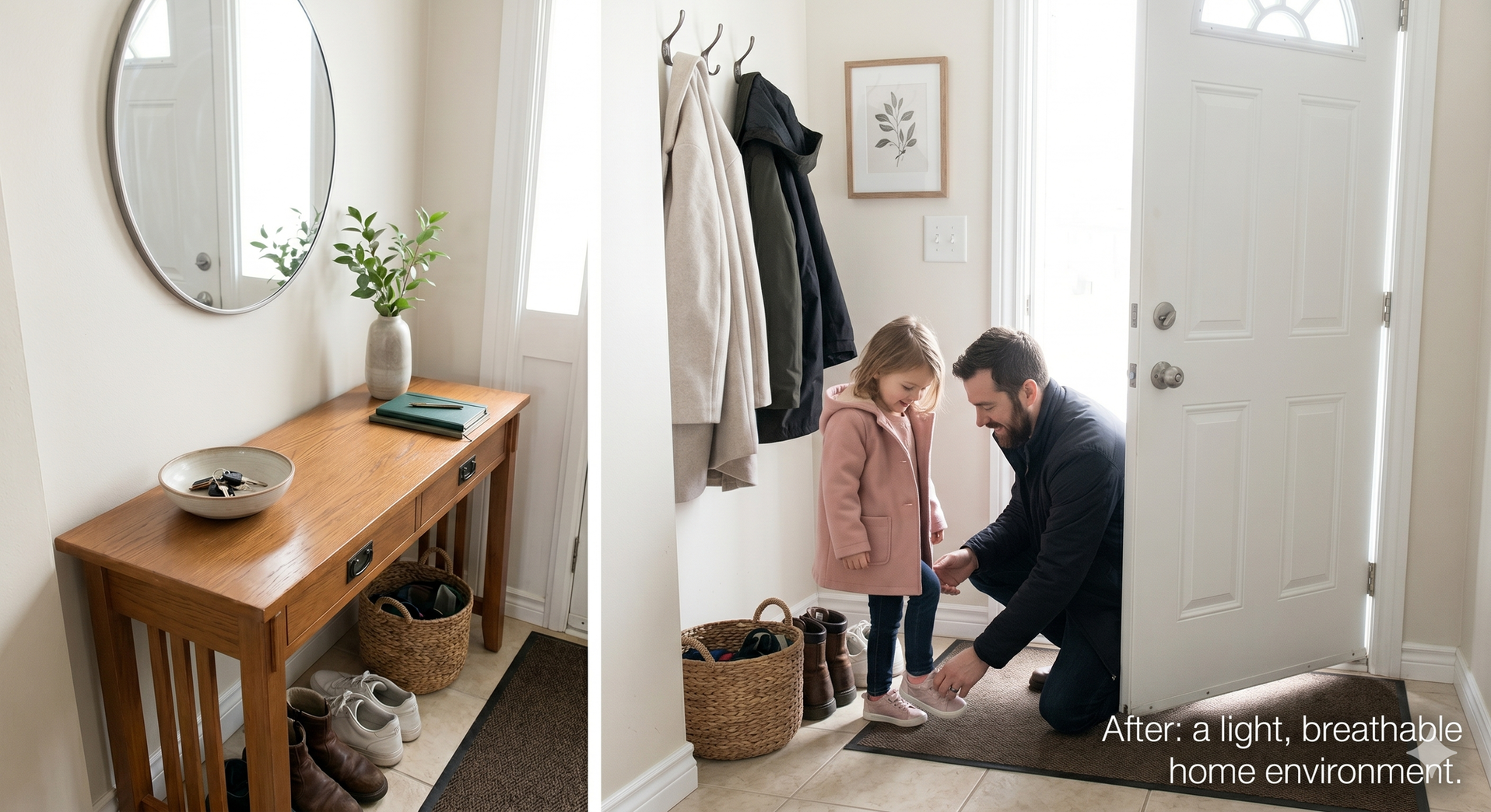
Bag → hook.
Keys → tray.
Post → inbox.
Charger → basket.
If returning something takes too many steps, the system will eventually be ignored.
The Home Team Reset helps your family make the right action the easy action.
LIFE AFTER THE RESET
What becomes
possible.
Not a perfect home.
A home with less repeated friction.
Fewer “Where is...?” questions
Fewer reminders about everyday things
Clearer places for bags, keys, post and school items
Less time spent resetting the same problems
A simple 10-minute rhythm when life gets busy
The goal is not to make your home look organised.
The goal is to make everyday family life easier to run.
Built for real homes.
Not a lifestyle brand version of it.
The Home Team Reset is designed for ordinary family life:
work, school, rushed mornings, tired evenings and imperfect weeks.
It does not depend on everyone suddenly becoming more disciplined.
It helps the household create three simple systems that fit how people actually live.
Then I would replace the current comparison table with something more relevant:
The Home Team Reset | Other Systems |
Start with the repeated problem | Start with the room |
Household agrees the default | One person organises |
Focus on daily friction | Focus on appearance |
Make the next action easier | Add more rules |
Build a simple recovery rhythm | Try to maintain perfection |
Fix three recurring household frustrations in 7 days.
GROUNDED IN RESEARCH
Not just theory.
Evidence-informed.
Four principles on which the system is built on:

Vsual clutter increases cognitive load
Fewer daily decisions reduce mental fatigue structurally, not temporarily
Environment shapes behaviour more reliably than motivation does
Small consistent maintenance prevents accumulation far more effectively than large resets
Based on findings from environmental psychology and recovery research.
This doesn't feel like motivation. It feels like relief.
From people like you
A quiet shift.
Then everything feels diffrent.
For the first time in years, the kitchen stayed usable through an entire week. Not just Monday morning. The whole week.

Hanna
Mother of three
I was sceptical — I've never finished a 7-day system. But the daily steps are short enough that I actually did them. All of them.

John
Teacher
The fridge card changed how our whole family operates. Ten minutes, everyone knows the routine. The weekend no longer starts with damage control.

Mikel and Sofie
Parents with 2 children
"I stopped spending every Saturday trying to reset the house. That time is mine now

Eveline
Entrepreneur in IT
WHAT'S INCLUDED
Everything you need to complete your 7-Day Home Team Reset
✓ 7-day guided program
✓ Home Team Friction Audit
✓ Default Builder
✓ Shared System Setup worksheets
✓ Busy-Day System Builder
✓ Home Team System Check
✓ 10-Minute Home Team Reset Card
✓ Lifetime digital access
Calm was never supposed to require this much effort.
Your home can work better when the systems are shared, simple and built for real family life.
Your calmer home starts with one decision.
Module 1 gives you the system to stop resetting and start moving forward.
FAQ
You are not trying to reorganise the whole home. You choose three recurring household problems and create shared systems that make those specific problems easier to manage.
Most days take about 15–20 minutes. The aim is to fit the reset into normal family life, not create another major project.
No. The key decisions are made together where useful, but not every family member needs to do every step.
Day 6 is specifically about testing and adjusting. If a system is awkward or gets ignored, you simplify the system instead of relying on more reminders.
Yes, as long as the system is adapted to what they can realistically reach and understand.
You can still use the program, but this is not a whole-home decluttering course. It focuses on three recurring friction points first.
Start simple.
Fix what keeps coming back.
Three recurring problems. One week. Shared systems that make everyday life easier.
The Home Team Reset is not about reorganising your whole home.
It is about choosing the three household frustrations that keep repeating — and replacing them with clear defaults your family can actually use.
In 7 days, you will:
identify the friction that keeps returning
agree what should happen instead
build three simple shared systems
test them against real family life
create a 10-minute reset rhythm for busy weeks
You do not need a perfect home.
You need a home that is easier to run together.
Part of The Intentional Living System™ by Obicet. Practical systems for a calmer, more intentional life.
Instant digital access. Use it on any device.


© 2026 Obicet. All rights reserved.